SUPREME COURT · EUTHANASIA PERMITTED FOR "DANGEROUS" DOGS · LAKH-SCALE BITES ACROSS INDIA · ZERO STATES WITH ADEQUATE ABC INFRASTRUCTURE · DEATHS REPORTED · AIRPORTS UNSAFE · THIS IS A GOVERNANCE FAILURE, NOT AN ANIMAL FAILURE     SUPREME COURT · EUTHANASIA PERMITTED FOR "DANGEROUS" DOGS · LAKH-SCALE BITES ACROSS INDIA · ZERO STATES WITH ADEQUATE ABC INFRASTRUCTURE · DEATHS REPORTED · AIRPORTS UNSAFE · THIS IS A GOVERNANCE FAILURE, NOT AN ANIMAL FAILURE

Gali Guardians · Open letter to the nation
The court is rightabout the problem.But is the cureacceptable?
What the court said
Article 21 protects every citizen's right to move freely — free from fear of attack. Children deserve safe streets.
+
What the court missed
Article 21 also protects sentient life. The Constitution demands governance deliver both human safety and animal welfare.
=
The only answer
The answer to a governance failure is not to kill animals — it is to build the governance promised for two decades.
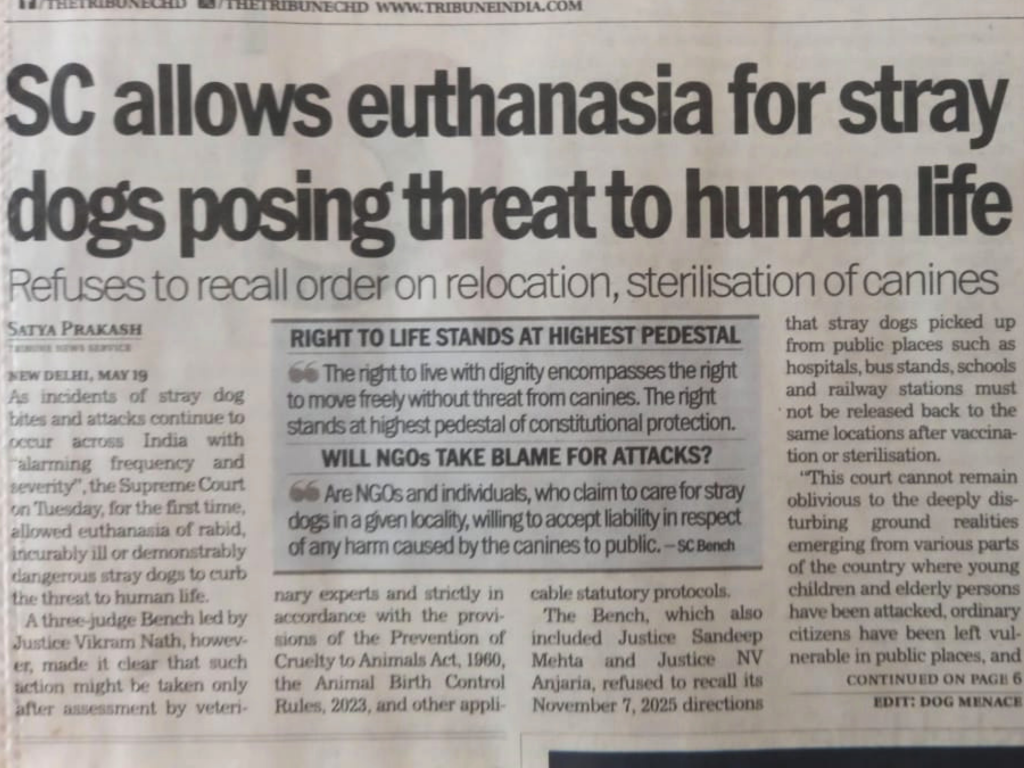
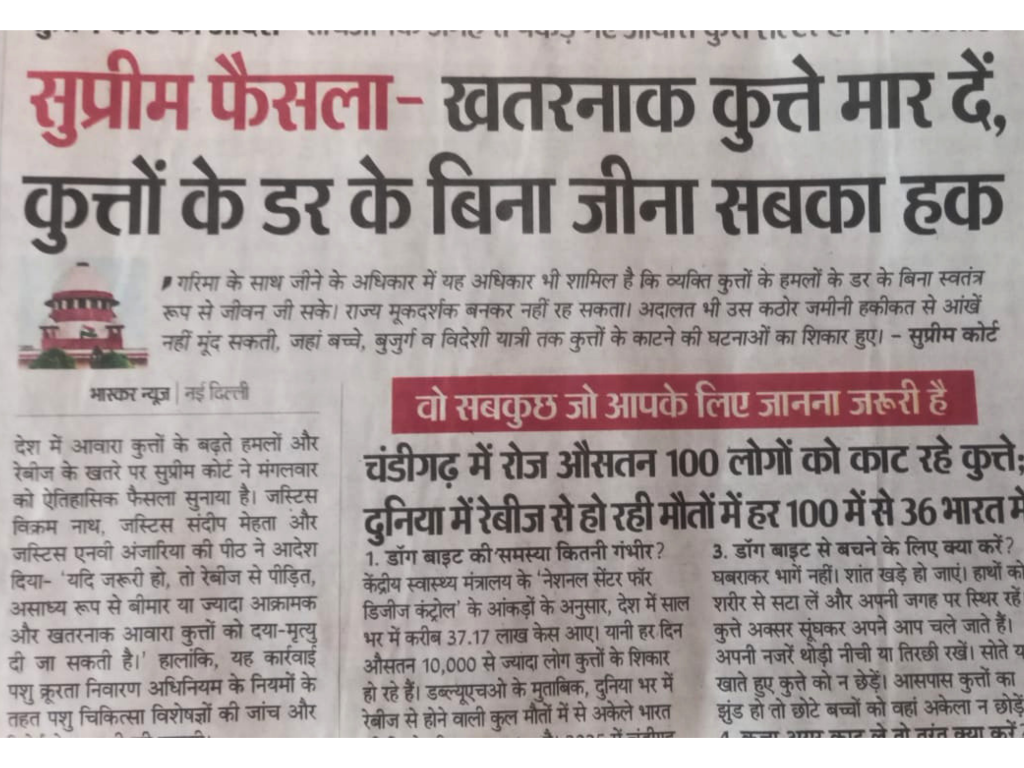
📰 As reported in national press
The Tribune
The Tribune
May 2026 · SC euthanasia ruling
Dainik Bhaskar
Dainik Bhaskar
May 2026 · SC euthanasia ruling
"The answer to a governance gap
is not to kill animals —
it is to build the governance."
— Gali Guardians

They deserve better than culling

How we got here:
a two-decade audit trail

The Supreme Court confirmed what welfare advocates have said for years — the state never built the infrastructure it was legally mandated to build. Every point below is documented on record.

2001
Animal Birth Control (Dogs) Rules introduced
ABC Rules mandate municipalities to sterilise, vaccinate and release stray dogs. A workable, humane framework — but with no enforcement mechanism and no funding mandate.
2001–2020
Two decades of non-implementation
Most states build zero ABC centres. Municipalities ignore the mandate. Animal welfare NGOs carry the entire load informally — underfunded, unrecognised. Dog population rises unchecked. Bite incidents increase every year.
2023
ABC Rules revised — infrastructure still absent
Updated ABC Rules give states clearer mandates. Implementation remained near-zero. No district-level centre targets were set. Funding remained discretionary. Nothing changed on the ground.
Mid-2025
Supreme Court suo motu proceedings begin
After a child is killed in a dog attack, the SC intervenes. An initial bench directs mass capture of dogs across Delhi — drawing immediate criticism for being inhumane and legally untenable.
Late 2025
Stray dogs ordered removed from all public institutions
SC directs removal from hospitals, schools, airports, railway stations. No rehoming plan. No shelter infrastructure. No timeline. Orders issued into a governance vacuum.
2026
Euthanasia permitted — the consequence of inaction
SC allows municipal authorities to euthanise "rabid, incurably ill, or demonstrably dangerous" dogs. Definition of dangerous left to local officials. Animal welfare groups now face tort liability for care they were providing to fill state gaps. The SC itself admits no state built the infrastructure it was ordered to build.

Six governance failures
behind the crisis

01
No ABC infrastructure built across two decades
The ABC Rules mandated municipal action in 2001. The Supreme Court confirmed that no state has adequate infrastructure. The framework was real. The will to build it was not.
Governance failure
02
Anti-rabies vaccine stockouts in government hospitals
The SC had to direct states to ensure anti-rabies vaccine availability. India still faces stockouts in public hospitals, forcing bite victims — often the poorest — to buy privately or remain unprotected.
Public health failure
03
No community ownership model was ever designed
The entire stray management burden was placed on anonymous municipal bodies with no stake in outcomes. Communities who live with these dogs were never given a role, training or recognition. Informal feeders were treated as liabilities, not assets.
System design failure
04
Zero education for children on animal coexistence
India's school curriculum has never included structured content on how to behave around stray dogs. The most preventable bite incidents involve children with no training. The state invested in no prevention. It is now investing in culling.
Education failure
05
No data, no mapping, no real-time tracking
India has no national stray dog census. No district-level population maps. No vaccination coverage data. Policy has been made without data for two decades. The SC cites newspaper reports — not government statistics — to quantify the crisis.
Data failure
06
Welfare groups punished for filling the state's gaps
Animal welfare organisations have been the de facto stray management system for decades. The court's order now makes them legally liable for dog bites if they feed dogs on institutional premises — criminalising the only functional system that existed.
Legal reversal

The court admitted
the state failed

"Despite nearly two decades having elapsed since the introduction of the ABC framework, there has been a discernible absence of sustained, systematic and incremental efforts on the part of States and Union Territories to expand and strengthen the infrastructure required to manage the steadily increasing stray dog population."

Supreme Court of India — 2026

"The right to live with dignity under Article 21 necessarily encompasses the right of every citizen to move freely and access public spaces without living under a constant apprehension of physical harm."

Supreme Court of India — 2026 — cited to permit euthanasia

The court is right about the problem. It is wrong about the cure. Article 21 also protects sentient life. The answer to a governance failure is not to kill animals — it is to build the governance.

⚖️
What "dangerous" means is undefined
The SC permits euthanasia of "demonstrably dangerous or aggressive dogs" — but leaves the assessment entirely to local municipal officials with no required veterinary qualification.
🐾
Welfare groups face new legal liability
Any group feeding dogs on institutional premises must now file formal liability undertakings — criminalising decades of community care that filled the state's own gaps.
No shelter plan for removed dogs
Dogs are to be removed from public institutions — but India has no shelter infrastructure to receive them. Removal without destination means abandonment or quiet culling.

Our action plan.
Six priorities.

Each action maps directly to a documented failure. We are not proposing charity. We are proposing the infrastructure the state was legally required to build — community-delivered, tech-enabled, and accountable.

Immediate
Priority one
Demand a moratorium on euthanasia without veterinary review
The court's euthanasia permission has no procedural safeguard as written. Municipal officials with no veterinary training can order a dog's death. We demand published criteria, mandatory veterinary sign-off, and a public appeal window before any order is executed.
  • File RTI for all euthanasia orders issued since the ruling
  • Petition municipal bodies to publish assessment criteria
  • Legal challenge where orders are issued without veterinary sign-off
Education
Priority two
Launch Safe Paws in schools across India
The most preventable bite incidents involve children with no training. Safe Paws is a structured Class 1–10 curriculum teaching safe coexistence — how to approach, feed, retreat, and report. We have the content. We need school access.
  • Partnership MOUs with municipal school boards in priority states
  • Pilot with community mobilisation networks, then scale
  • Train teacher-guardians as in-school Safe Paws champions
Community
Priority three
Formalise every informal dog feeder as a Gali Guardian
Thousands of Indians already feed, track and care for neighbourhood strays. The court's new liability rules threaten them. We flip the framing — register them, train them, give them ID cards and municipal recognition. Convert liability into infrastructure.
  • Launch Guardian registration through a digital platform
  • Co-produce training modules with veterinary partners
  • Advocate for official municipal recognition and indemnity framework
Technology
Priority four
Build India's first open stray dog mapping database
There is no national stray dog data. The court cited newspapers, not statistics. A digital platform can change this. Every Guardian geo-tags dogs, logs vaccination status, and flags behavioural changes — building the data layer the government never did.
  • Stray dog mapping — geo-tag, photo, vaccination log, temperament flag
  • Open API for municipal ABC bodies to access and act on data
  • Regular public data releases to build the evidence base for policy
Infrastructure
Priority five
Co-fund ABC centres with state governments
The court has directed at least one ABC centre per district. States will struggle to comply alone. We propose a Gali Guardians co-funding and co-management model — private capital plus community operations plus government land and mandate.
  • Identify priority high-bite districts for first centres
  • Build partnership model with state animal husbandry departments
  • Raise a dedicated ABC infrastructure fund
Legal
Priority six
Submit Gali Guardians model as amicus brief to High Courts
The court has directed all High Courts to initiate suo motu proceedings on stray dog management. This is a direct opening. We file Gali Guardians as a model community compliance framework — giving courts a concrete alternative to endorse.
  • Engage animal law advocates to file amicus in priority High Courts
  • Prepare Gali Guardians compliance model document for submission
  • Connect with All India Animal Welfare Association for joint brief

Who needs to act

Central government
Ministry of Fisheries, Animal Husbandry & Dairying
  • Allocate dedicated budget for district ABC centre construction
  • Mandate anti-rabies vaccine availability in all government hospitals
  • Commission a national stray dog census
  • Create a formal Guardian recognition framework under ABC Rules
State governments
Animal Husbandry & Municipal Departments
  • File ABC centre status reports per Supreme Court order
  • Adopt Gali Guardians as community stray management partner
  • Integrate Safe Paws into Class 1–10 school curriculum
  • Publish euthanasia criteria — no silent culling orders
Communities & civil society
Citizens, Feeders, Welfare Groups
  • Register as a Gali Guardian — formalise the care you already give
  • Use the Guardian platform to map, vaccinate and tag neighbourhood strays
  • Enrol children in Safe Paws — speak to your school
  • Sign the petition and share it widely
Gali Guardians · Open letter to India

Don't kill the dog.Fix the system.

The infrastructure was never built. The community was never empowered. The data was never collected.
Gali Guardians does all three.

🔒 Free to signNo spam, everSent to policymakers